

If you own childcare locations and still feel like you’re everywhere, let’s clear something up.
It’s not because you’re doing something wrong.
It’s because you can’t clearly see what’s actually happening.
Most CEOs don’t need more meetings. They need visibility.
What I see consistently across childcare organizations is this: CEOs believe their challenge is onsite management, when the real issue is that classrooms are not standardized. When classrooms run differently, leadership has to overcompensate—and that burden always rolls uphill to the CEO.
That’s where chaos comes from.
Not your people.
Not your effort.
The lack of structure.
When your classrooms are inconsistent, your leadership team is forced to react instead of lead. The CEO ends up stepping in, fixing problems, and filling gaps that systems should already be handling.
This is why we focus on activating the classroom foundation—routines, flows, expectations, and structure—so classrooms begin to run the same. Once the foundation is in place, visibility follows naturally.
Without that foundation, you’re leading from feelings instead of data. And feelings don’t scale.
Operating like a CEO requires a daily plan that reflects what’s actually happening in your organization—operations, compliance, training, and leadership activities.
When your plan is rooted in data, you gain clarity. You’re no longer guessing or reacting. You know where your attention is needed and why.
The biggest challenge CEOs face is not recognizing issues early because there’s no task management system in place. Childcare is organized chaos—but without systems, it becomes unmanageable chaos.
If you’re a sharp CEO and still feel overwhelmed, the issue isn’t capability. It’s visibility.
The moment you believe problems can only be solved when you walk into your facilities, you’ve identified the real issue.
It’s not your team.
It’s the structure.
There has to be an identity shift—from operator to executive. CEOs should not be executing. CEOs should be leading teams that are trained to execute.
This is why classroom foundation systems and leadership development are essential. Executive strength comes from understanding your task management systems, training systems, onsite leadership, and oversight structure.
When that foundation is missing, everything feels chaotic. When it’s in place, leadership becomes smooth and intentional.
At a certain level, hustle stops working.
Growth must be built on systems.
There should be a daily closeout process that provides data—data that shows where attention is needed. Without it, CEOs make reactive decisions: freezing hiring, guessing rates, closing locations, or combining sites due to enrollment challenges that didn’t happen overnight.
Those decisions are signs of missed checkpoints—moments where data wasn’t used, and systems weren’t guiding leadership.
Marketing needs a system.
Enrollment needs a system.
Operations need a system.
Without them, you fall back into hustle, and hustle always pulls you backwards.
Control does not come from micromanaging.
It comes from operating like a CEO.
CEO mindset.
CEO tools.
CEO systems.
CEO identity.
When you lead this way, your business moves from chaos to control—not because your people changed, but because you did.
If you’re ready to stop guessing and start leading with clarity:
→ Watch the Video to see how visibility changes everything
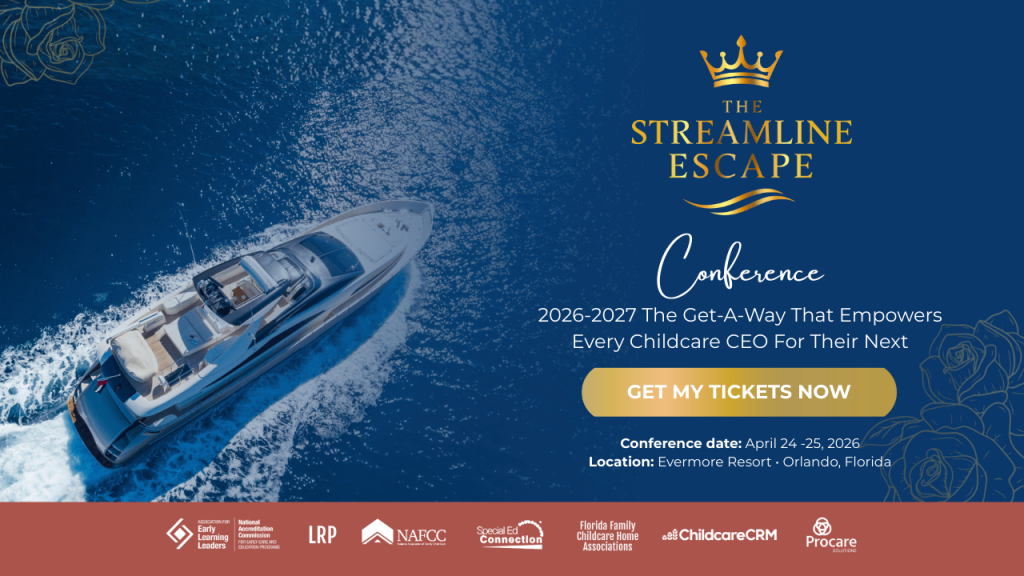
→ Join Streamline Escape for a space to step away, recalibrate, and return operating at the executive level
This is the next level of leadership.
